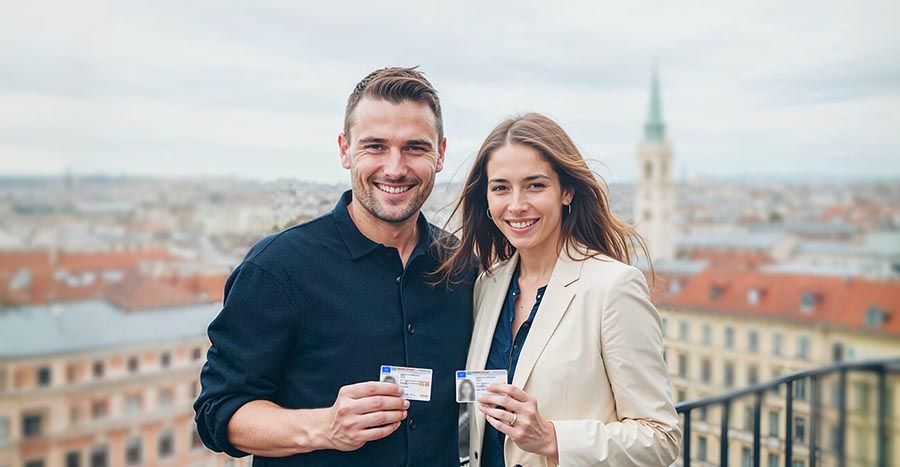


A Malta residence permit is a plastic card issued to non-EU citizens that grants them the right to reside legally in Malta for its validity period. It is important to distinguish between a standard residence permit and an eResidence card. The latter is intended for EU citizens staying in Malta for more than 3 months and who must register their place of residence.
Unlike a permanent status, a residence permit is issued for a limited period (1-5 years) and must be renewed regularly. Permanent residence can be obtained through investment or settlement. EU Long-Term Residence status is granted under Directive 2003/109/EC to individuals who have resided in Malta for at least 5 years. Residents can also apply for citizenship after 5 years of residence in the country. A passport provides a person with a complete set of rights, including visa-free travel to over 170 countries, freedom of residence, employment, and business in the EU, unlike a temporary or permanent residence permit.
The Malta Identità Agency is responsible for processing residence permits. This government agency accepts documents, processes residency applications, verifies compliance with immigration laws, and issues residence cards.
10 legal ways to obtain residency in Malta in 2026
Currently, a Maltese residence permit can be obtained for 1-5 years, depending on the immigration basis. We compared the most popular methods:
| Basis for residence | Eligible applicants | Primary requirement | Validity period |
|---|---|---|---|
| Real estate | Real estate investors or tenants | Purchase or lease property meeting the required minimum investment threshold | Indefinite |
| Startup establishment | Startup founders, aspiring entrepreneurs | Register a startup and invest at least €25,000 | 3 years |
| Digital Nomad | Remote workers | Annual income of at least €42,000 | 1 year |
| Employment (Single Permit) | Migrant workers | Employment in Malta | 1 year |
| Employment (Key Employee Initiative) | Highly-skilled professionals | Gross monthly salary of at least €3,750 | 1 year |
| Employment (EU Blue Card) | Highly-skilled professionals | Gross monthly salary of at least €3,095 | 2 years |
| Family reunification | Family members of Maltese residents | Proof of family relationship | 1 year |
| Studies | Student | Admission to a higher education institution | 1 year |
| Residency | Wealthy individuals | Eligible property purchase/lease and payment of annual income tax | 1 year |
| Retirement | Retirees | Receipt of a Maltese state pension and the purchase/lease of eligible property | Up to 5 |
Residency through real estate
Renting or purchasing real estate in Malta or Gozo qualifies you for permanent residence under the Malta Permanent Residence Programme (MPRP). To keep the residence permit, you must own the property for at least 5 years. The main costs for investors are:
| Cost item | Property purchase | Property rental |
|---|---|---|
| Minimum property value, € | 375,000 | 14,000 (per year) |
| Non-refundable administrative fee, € | 60,000 | 60,000 |
| Permanent residence contribution, € | 37,000 | 37,000 |
| Donation to a cultural, charitable, or other NGO, € | 2,000 | 2,000 |
| Additional fee per accompanying family member, € | 7,500 | 7,500 |
In addition to the investment and fees, the applicant must prove ownership of assets:
- at least EUR 500,000, of which EUR 150,000 must be in financial assets;
- at least EUR 650,000, of which EUR 75,000 must be in financial assets.
Permanent residence permits may be granted to the investor’s immediate family members:
- Spouse or common-law partner.
- Minor children of the couple or one of them.
- Children aged 18 to 29 who are unmarried and financially dependent on the investor.
- Parents and grandparents of the partners who work part-time and are financially dependent on the investor.
- A child of any age with a confirmed disability.
All applicants for Maltese permanent residence permits must undergo a comprehensive due diligence process. The procedure involves determining whether the investor’s real estate purchase or rental funds were earned legally, whether the applicant has a criminal record, and whether there are any outstanding taxes.
Residence permit through a startup
The Malta Startup Residence Programme is a government program that provides a 3-year residence permit, which can be extended for an additional 5 years. Eligible applicants include:
- Founders and co-founders of startups.
- Core employees of an innovative company who are essential to the business’s launch.
- Relatives of founders and core employees (spouses, partners, and children).
In order to participate, you must:
- Intend to develop a business in Malta in the fields of manufacturing, software development, industry, biotechnology, pharmaceuticals, healthcare, green and sustainable industries, or other innovative economic activities;
- Be the founder of a company that was registered no more than 7 years ago. The company must not have been created through a merger or reorganization of another company;
- Be over 18 years old;
- Invest at least EUR 25,000 in the startup and/or its share capital (if more than 4 founders are applying for a residence permit, an additional EUR 10,000 is required for each additional founder);
- Have health insurance and sufficient funds to support themselves in Malta;
- Have a clean criminal record.
Applications must be approved by Malta Enterprise and Residency Malta, the agencies responsible for issuing residence permits. You may be granted a residence permit extension if both Malta Enterprise and Residency Malta confirm that your company continues to operate in the country and that its founders and employees continue to meet all program requirements.
- Quick assessment of the project and its chances
- Clear requirements and transparent deadlines
- A team with 15+ years of experience in European residence permits
Digital Nomad residence permit
Malta has a government program that issues 1-year digital nomad residence permits. Foreign nationals without EU, EEA, or Swiss citizenship are eligible if they meet one of the following requirements:
- Work for a foreign company under an official employment contract.
- Conduct business outside of Malta and/or be shareholders or partners of such a company.
- Work as a freelancer and provide consulting services to international clients under formal contracts.
Important: employment must be remote. This means a residence permit is issued only to individuals who are not tied to a workplace and can perform their duties using a computer or phone.
You must demonstrate a minimum annual income of EUR 42,000 (EUR 3,500 per month) earned outside of Malta. You must also demonstrate that you have sufficient funds to support yourself in Malta for 5 months from the date of your application. While the requirements don’t specify an exact amount, we recommend showing the authorities that you have at least EUR 3,500 per month for living expenses. This means you must have at least EUR 17,500 in your bank account.
Digital nomads cannot work, even indirectly, for Maltese companies. Furthermore, applications from citizens of 11 countries are not accepted. In comparison, Spain allows freelancers to enter into contracts with local clients, provided such employment does not exceed 20% of their total workload.
Residence permit through employment
A Maltese regular residence permit obtained through employment (Single Permit) is one of the most common ways to obtain legal residency in the country. In 2024 alone, more than 14,500 initial permits were issued; in 2023, over 27,800 were issued. The residence permit is valid for 1 year and can be renewed indefinitely.
Residence permits are available to individuals who have received a job offer from a Maltese employer registered with the government employment agency, Jobsplus.
Applications for residence permits cannot be submitted independently; they must be submitted by a potential employer. This permit only grants the right to work in Malta, specifically in the position specified in the application.
Other individuals who are eligible for employment-based residence permits include:
- Seasonal workers, for a maximum of 6 months with no option for renewal.
- Scientists coming to Malta for research.
- Tourism and hospitality professionals under the Skills Pass program.
Employment-based residence permits in Malta are also available to highly qualified specialists:
- EU Blue Card: For foreigners with a university degree or ten years of experience, a minimum 6-month contract offer, and a salary of EUR 3,095 per month.
- Key Employment Initiative (KEI): For executives and highly technical specialists with a proven education and/or work experience, and a salary of EUR 3,750 per month.
- Specialist Employee Initiative (SEI): For individuals with qualifications relevant to the intended job, or 3 years of experience, and an expected salary of EUR 2,500 per month.
Difficulties in obtaining a residence permit through employment stem from the application process and the requirements for both applicants and employers. Depending on the chosen program, different educational and qualification documents must be submitted. Maltese employers can also make mistakes. For instance, before hiring a foreign national, employers must advertise the vacancy on Jobsplus and demonstrate that no suitable Maltese or EU candidates applied.

Residence permit for students
Residence permits in Malta are available to individuals who come to study at a university licensed by the National Higher Education Commission (such as the University of Malta, the American University of Malta, and others). The studies must be full-time.
Those who can travel visa-free within the EU must apply for a residence permit within 3 months of arrival. Others must first obtain a student visa and then apply for a residence permit upon arrival.
Typically, Maltese university staff provide international students with clear admissions instructions, including which secondary education documents are required and which English language test they must pass.
Students receive a Maltese residence permit valid for up to 1 year, which may be renewed multiple times until graduation.
Residence permit for retirees
The Malta Retirement Programme (MRP) is a government program that grants residence permits to foreigners who have worked in Malta and have retired there. Residence permits are issued to applicants who:
- Provide documented proof that all payments are received from the Maltese budget and that the total amount is at least 75% of their taxable income.
- Are able to cover their living expenses in Malta without social assistance.
- Have obtained health insurance that is valid throughout the EU.
- Have sufficient knowledge of Maltese or English to maintain a conversation.
- Are physically and mentally healthy.
- Waive all benefits to which they are entitled under the Global Residence Program, Highly Skilled Persons Rules, UN Pension Rules, and other regulations.
- Purchase or rent real estate in Malta of a certain value.
To clarify, a pensioner must own property valued at least EUR 220,000 if it is located in southern Malta or on the island of Gozo. Otherwise, the house or apartment must be worth at least EUR 275,000. Alternatively, you can choose to rent. The annual rent must be at least EUR 8,750 if the property is located in southern Malta or on the island of Gozo, and EUR 9,600 elsewhere.
Employment is prohibited with this type of residence permit. However, charitable, scientific, and educational activities are permitted, as are activities related to establishing public trusts and foundations.
Retirees are granted residence permits valid for up to 5 years, renewable. To maintain the permit, you must reside in Malta for at least 3 months per year.
Residence permit through family reunification
A foreigner who has lived in Malta for at least 1 year with a residence permit and is eligible for permanent residence may apply for family reunification. Those eligible for a residence permit include:
- a spouse who is over 21 years of age;
- minor children of the inviting person and their partner.
The family reunification application must be submitted by the inviting person. The sponsor must include passports and proof of family ties (e.g., marriage or birth certificates) for each relative. The sponsor must also provide housing, insurance, and living expenses for each relative. Authorities may interview each applicant to verify family ties.
A residence permit is issued for a maximum of 1 year, provided that the inviting person’s residence card is valid for at least that period. This status can be extended if the main applicant continues to meet all requirements.
Residence permit through tax residency
Through the Malta Global Residence Programme (GRP) or the Residence Programme (TRP), a Maltese residence permit can be obtained for 1 year, renewable for 2-year periods. EU, Icelandic, Liechtensteinian, Swiss, and Norwegian citizens are eligible for the TRP, while all other foreigners are eligible for the GRP.
To participate, you must:
- Purchase or rent real estate.
- Have sufficient funds to live in Malta.
- Spend more than 183 days per year in the country.
- Have insurance that is valid in Malta and other EU countries.
- Have sufficient knowledge of English or Maltese.
- Prove a clean criminal record.
Under the GRP/TRP, the property purchased in Malta must be valued at a minimum of EUR 275,000. If the property is located in the southern part of the country or on the island of Gozo, the minimum price is EUR 220,000.
If you are renting, your contract must be for at least 1 year. The annual rent for real estate in Malta cannot be less than EUR 9,600, and in the southern part of the country and on the island of Gozo, it cannot be less than EUR 8,750.
Only the program participant and their immediate family members may live in the purchased or rented property.
An administrative fee of EUR 6,000 applies to applications, except for properties in southern Malta, for which the fee is EUR 5,500.
Step-by-step guide: how to obtain a residence permit in Malta
Obtaining a residence permit in Malta is a well-defined process with 5 main stages. We have compiled this guide to help you understand the process of obtaining Maltese residency.
Step 1. Determine the basis for obtaining a residence permit
The first and perhaps most important step is choosing the basis for obtaining a residence permit. To determine the right option for you, study the details of each method and apply the conditions to your situation. For example, depending on your salary, you may be eligible for an EU Blue Card or for participation in the KEI/SEI program if you meet the criteria for a highly qualified specialist.
Step 2. Prepare the documents
The full set of required documents for a residence permit depends on the basis for the application. However, here is a basic list:
- a passport valid for at least 8 months from the application date;
- an insurance policy with minimum coverage of EUR 100,000 for the entire intended period of residence in Malta;
- a rental or purchase document for a property in Malta.
All documents issued in a language other than English or Maltese must be translated. Some documents (e.g., a certificate of good conduct) must be apostilled if the issuing country is a member of the Hague Convention or otherwise legally certified.
Step 3. Apply for a residence permit
Most Maltese residence permit applications must be submitted online through the government portal Identità. Register with the service, complete the form, and attach scanned copies of your documents.
However, depending on the reason for the residence permit request, the government agency handling the application may vary. Digital nomads, for example, apply for residence permits through the Residency Malta Agency portal.
Step 4. Biometrics and review
After submitting your application, Identità begins the review process. The processing time depends on the type of residence permit requested. Migrant workers, for example, wait 2 to 4 months, while digital nomads wait 90 days.
If the application is approved, Identità will issue the applicant a letter of approval in principle. This document specifies the validity period, which cannot be extended. This letter does not replace a residence permit; rather, it indicates that you can proceed with the following steps:
- Apply for a visa at the embassy or consulate (if required).
- Book an appointment with Identità online to provide biometric data.
- Enter Malta and visit Identità in person to provide biometric data and present all original documents.
Step 5. Receive a residence card and register your address
After entering Malta, visit an Identità office on your appointment date. During your visit, bring the documents specified in the approval letter, as well as the documents you attached to your online residence permit application.
You will be asked to provide biometric data, including a photo and fingerprints, at the appointment. After this procedure and document verification, you will be issued a temporary permit authorizing you to reside lawfully in Malta until you receive your residence card. The permit has a limited validity period, as indicated on it.
Once Identità has processed your application, you will receive a notification and a PIN instructing you to return to the government office to pick up your residence card. You do not need an appointment; permits are issued on a first-come, first-served basis weekdays from 7:30 a.m. to 1:00 p.m.
After receiving your residence card, you must register your Maltese residential address with Identità online. You must notify the government office of any change of address. Otherwise, your Maltese residence status may be revoked.

Would you like to apply for an EU residence permit without any risks and with turnkey support? — we will assign you a personal manager.
Costs and processing times
The government fee and processing time for a Maltese residence permit application vary depending on the application method:
| Basis for residence | Government fee, € | Processing time, days |
|---|---|---|
| Real estate investment (MPRP) | 37,000 | 120–180 |
| Startup | 1,050 | 180–210 |
| Digital Nomad | 400 | 90 |
| Employment (Single Permit) | 600 | 60–120 |
| Employment (EU Blue Card) | 600 | 90 |
| Employment (KEI) | 600 | 5 |
| Studies | 50 | 90 |
| Retirement (MRP) | 2,500 | 180–360 |
| Family reunification | 50 | 60 |
| Tax residency (GRP / TRP) | 5,500–6,000 | 90–120 |
Required documents for Malta residency
The required documents vary depending on the application method.
MPRP participants must prepare the following:
- A completed application form, FORM MPRP 1.
- A passport.
- Civil registration documents (such as a birth or marriage certificate).
- Bank statements, tax returns, and other documents demonstrating financial solvency.
- Proof of purchase/rental of real estate in Malta.
Startup founders are required to submit the following:
- A passport.
- A certificate of no criminal record.
- Bank statements or other documents confirming financial solvency.
- Company incorporation documents.
- Proof of investment in the startup.
- Proof that the innovative company has been operating for no more than 7 years.
- Proof of accommodation in Malta.
- Proof of intent to become a tax resident in Malta.
- A health insurance.
The following documents are required for a digital nomad:
- A completed Form N4 GDPR application (submitted online when applying).
- A passport.
- A CV.
- A motivation letter describing the purpose of the move and residence permit application.
- Bank statements for the last 3 months.
- A certificate of no criminal record no older than 6 months.
- Proof of employment (contracts with clients, employment contracts, etc.).
- Marriage certificates and birth certificates of children (if including relatives in the application).
Individuals planning to obtain a Malta residence permit through employment (Single Permit) must prepare the following documents:
- A completed application form C2 (form C5 if you live outside Malta).
- An original and a copy of your passport.
- A resume in Europass CV format.
- An insurance policy.
- A health certificate (applicable only to citizens of certain countries).
- A copy and original of your employment contract.
- Jobsplus documents (a statement of vacancy posting and eligibility, a job description, and proof of vacancy advertising).
- Proof of qualifications from the Malta Centre for the Recognition of Qualifications and Information.
- A rental agreement for residential property in Malta or a title deed for the property.
- A confidentiality agreement signed by the employer and the applicant.
Applicants for an EU Blue Card must collect the following documents:
- A completed CEA form B.
- A full copy of your passport, including blank pages.
- A signed employment contract stating the salary.
- A resume using the Europass CV template.
- A job description.
- A statement of compliance with all Jobsplus requirements.
- Proof that the vacancy was advertised on Jobsplus for at least 2 weeks within 2 months prior to the residence permit application date.
- Proof of qualifications from the Malta Recognition and Information Centre.
- A health certificate, if applicable.
- Proof of owning or renting accommodation in Malta.
- An approval letter from the Malta Housing Authority.
- A completed rental agreement confirmation form.
- An insurance policy.

Those immigrating under the Key Employment Initiative must provide the following:
- A completed application form C2 KE2.
- A full copy of the passport, including blank pages.
- A cover letter from the Maltese employer explaining why the position is needed.
- A contract with the employer stating the salary.
- A resume using the Europass CV template.
- Proof that the vacancy was advertised on Jobsplus for at least 2 weeks within 2 months prior to the KEI application date.
- A statement of compliance with all Jobsplus requirements.
- Proof of qualifications from the Malta Recognition of Qualifications and Information Centre.
- Letters of reference (if the applicant does not have a relevant education but has 3 years of work experience).
- A health certificate (if applicable).
- A lease/purchase agreement for the property.
- An approval letter from the Malta Housing Authority for the rental of the property and a completed rental agreement certification form.
- Insurance policy.
- A driver’s license (if applicable).
- A qualification pass (only for those who will be working in the tourism/hospitality sector.
Students must prepare the following:
- A completed application form 01.
- A full copy of their passport with blank pages.
- A copy of the acceptance letter from the educational institution.
- A copy of a bank statement for the last 3 months.
- A health certificate (if applicable).
- An insurance policy.
- A copy of the property lease agreement or title deed (if not staying in the educational institution’s residence halls).
- Approval from the Malta Housing Authority for the rental of the property, as well as a completed rental agreement certification form.
- A copy of the birth certificate and parents’ passports, as well as their permission to issue a residence permit (for minors).
MRP participants (retired applicants) must provide the following:
- Application form for participation in the MRP.
- Receipt for payment of the administrative fee addressed to the Revenue Commissioner.
- 2 recent photographs.
- Copy of the first page of the passport.
- Apostilled original birth certificate.
- Marriage certificate with an apostille (if applicable).
- Police clearance certificate issued no more than 6 months ago in the country of last residence with an apostille.
- Affidavit of allegiance.
- Proof of pension income.
- Copy of a registration certificate or residence permit.
- Property lease or purchase agreement.
- Insurance policy.
Applicants for family reunification must provide the following:
- A completed application form 01.
- A cover letter from the sponsor stating the reasons for requesting a residence permit.
- Evidence that the sponsor can obtain permanent residence in Malta in the future.
- A copy of the sponsor’s residence permit.
- A marriage certificate, birth certificate (for children), or other documents confirming family ties.
- Evidence that the sponsor has accommodations in Malta large enough for the entire family.
- A copy of the property lease or title deed.
- A copy of the letter from the Housing Authority confirming the lease registration.
- Bank statements from the sponsor showing proof of monthly income of at least EUR 2,063 for the sponsor and 20% (EUR 413) for each family member.
- Insurance policies for all relatives.
- Passport copies for all family members.
- Health certificates (if applicable).
Participants in the GRP and TRP (Tax Residency Program) must provide the following:
- An application for participation in the program (GRP or TRP form).
- A receipt for payment of the mandatory administrative fee.
- 2 recent photographs.
- A certified copy of the main page of the passport.
- A birth and marriage certificate (if applicable) with an apostille.
- A police clearance certificate from the country of last residence, issued no more than 6 months ago.
- Affidavit of allegiance.
- A copy of the lease or sale agreement for the property.
- A declaration by the applicant and their dependent children aged 18–25 that they are not economically active.
- An insurance policy for the applicant and their dependents.
We will collect and prepare a package of documents as required by the European Union authorities
Maintaining your residence permit status in Malta
After receiving your residence permit, monitor the validity of your residence card carefully and renew it promptly. The process is similar to the initial application process: gather the necessary documents, submit an online application, wait for a decision, and then visit Identità in person. You can only request an extension while your current residence card is still valid. Therefore, it’s best to begin the process 3 months in advance. That will allow enough time for the documents to be prepared and for the Maltese authorities to review the application.
If you change your address in Malta, you must notify Identità by submitting an online application with the following attachments:
- a copy of your residence permit;
- a copy of your new lease/purchase agreement;
- a rental declaration form;
- an approval letter from the Housing Authority.
There is a EUR 50 state fee for submitting an application to change your residential address.
Common reasons for rejection and how to avoid them
Rejection of a Maltese residence permit is most often due to an incorrect set of documents or failure to comply with all legal requirements. The application will be rejected if the applicant provides an expired police clearance certificate; fails to translate required documents into English or Maltese; or fails to prove financial solvency.
To avoid a denial of a residence permit, carefully review the terms and conditions. For example, EU Blue Card applicants, digital nomads, and KEI program participants must ensure their salaries meet the minimum requirements. Real estate investors should verify the value of the property they are purchasing or renting with documentation. Therefore, many seek the support of lawyers, who can consider all the details, help select a program for relocating to Europe, and support applicants throughout the process.
Taxes and tax residency status
Temporary and permanent resident status are 2 different things. Obtaining a temporary/permanent residence permit only grants the right to live in Malta. They become tax residents if they reside in Malta for more than 183 days in any given year. In this case, they are required to pay taxes:
- Upon employment: income tax ranging from 0% to 35%, depending on income;
- Upon opening a business (legal entity): corporate tax at a rate of 35%;
- When registering as a sole proprietor: income tax ranging from 0% to 35%, or 10% for part-time work.
Malta offers programs that grant immigrants special favorable tax status: the Global Residence Programme, the Malta Retirement Programme, and the Residence Programme. Separate rules apply to income earned abroad and remitted to Malta in these cases. Participants in the GRP and TRP programs pay a minimum of EUR 15,000 per year, while pensioners pay EUR 7,500 for themselves and EUR 500 for each dependent. A tax deduction of EUR 0.15 per euro is paid to the treasury, provided it is at least the established threshold.
How to obtain permanent residency and citizenship in Malta
You can become a permanent resident of Malta if you meet the following requirements:
- You have lived in the country for 5 years with a permanent residence permit.
- You have proven your financial solvency.
- You have proven that you own/rent a home.
- You have met the integration requirements.
The last requirement is to complete a 100-hour course organized by the Malta Employment Service or another competent authority within 1 year prior to applying for permanent residency. During the course, you will study the country’s social, cultural, economic, and democratic history. After the course, you must pass an exam with a score of at least 75%. You must also have your secondary or vocational education diploma certified in Maltese.
There is a way to obtain permanent residency in Malta more quickly without meeting all the residency and integration requirements. To qualify, you must participate in the Malta Permanent Residence Programme by purchasing or renting property.
Maltese citizenship is granted after 5 years of continuous residence in the country, including the final year of uninterrupted residency.
Obtaining temporary or permanent residency or a second passport is a complex legal process that requires careful preparation and a solid understanding of immigration rules. iWorld specialists help you choose the right immigration route, explain the key details and nuances of each option, prepare the required documents, and support you at every stage of the procedure. To complete your legalization process abroad safely and confidently, rely on the expertise of iWorld lawyers. Your first consultation is free.
Get a personalized plan for obtaining a residence permit
- Recommendations for suitable programs
- Individual calculation of budget and deadlines
- Checking odds and requirements
- Turnkey support from a team with 15+ years of experience

Leave an application and get a consultation specialist