
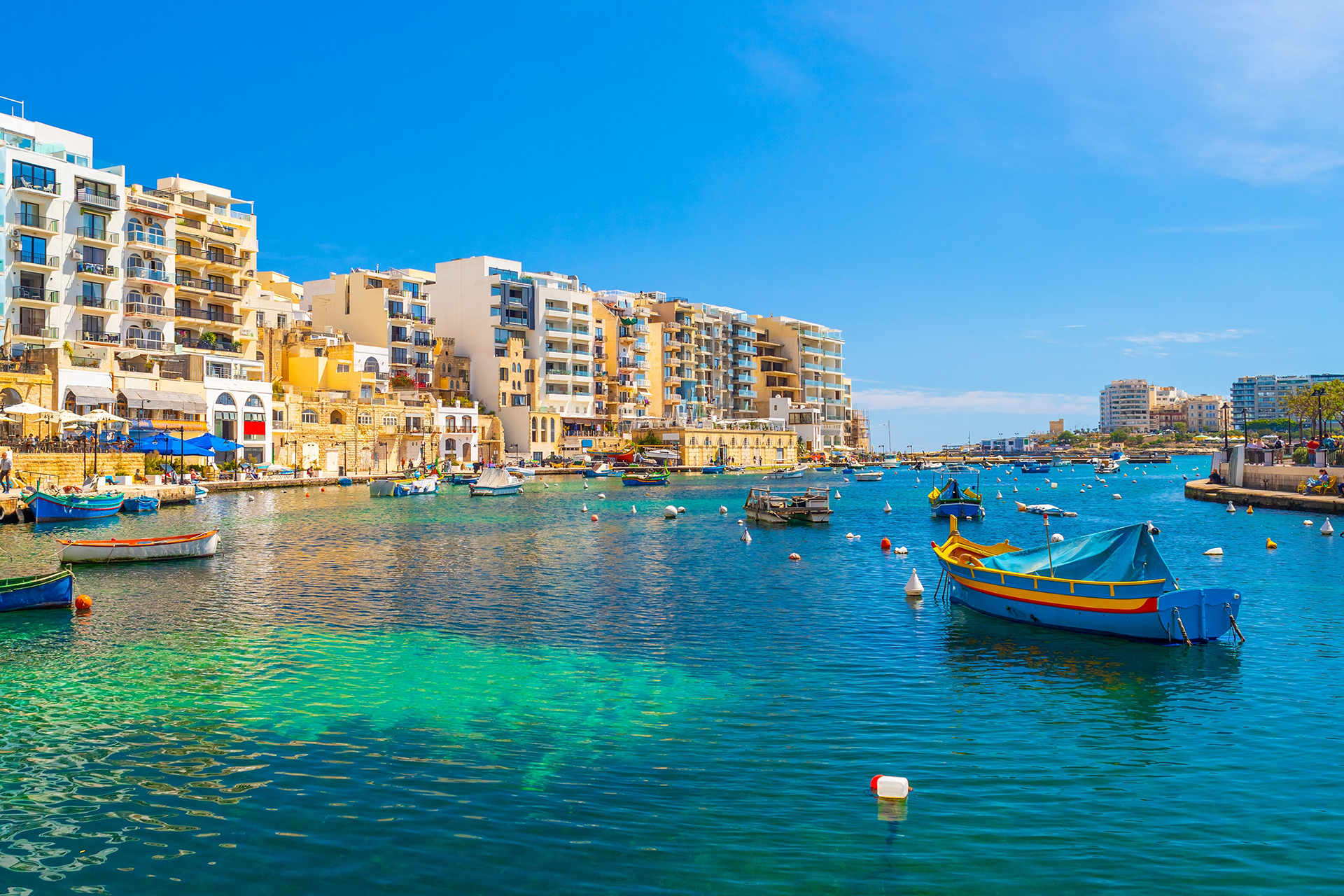
The Malta Digital Nomad Visa program is for foreign workers who want to live in the EU. It is ideal for freelancers (e.g., designers, IT specialists, and translators), entrepreneurs, and individuals who can perform their job duties without being tied to a specific location. The program has a high approval rate—78% of applicants receive a positive decision.
Unlike a tourist visa, the Malta Digital Nomad Visa allows you to live in the country for 12 months, which can be extended 3 times. However, it’s not a work visa, which allows you to be employed by local companies. Unlike Spain’s Digital Nomad Visa, which grants the right to sign contracts with local clients, Malta’s visa only permits work with foreign clients.
Advantages of the Malta Digital Nomad Visa for Remote Workers
Remote workers choose Malta for:
- Living in an EU country: Malta officially joined the European Union in 2004.
- Visa-free travel within the Schengen Area: With a Maltese residence permit, you can visit member states for up to 3 months within a 6-month period.
- Tax optimization: Digital nomads pay a reduced income tax rate.
- Living in an English-speaking environment: Local residents understand and speak English fluently.
- Access to European medicine: The opportunity to obtain a European Health Insurance Card (EHIC) and use it to receive medical care at any EU clinic.
Requirements for a Maltese Digital Nomad Visa
In Malta, a digital nomad visa is issued to individuals over 18 years of age who work remotely (using a phone or computer) and who are not citizens of any EU, EEA, or Swiss country.
To qualify as a digital nomad in Malta, an individual must:
- work for a foreign company under a formal employment contract;
- conduct business abroad independently or as a shareholder/partner in a company;
- work freelance outside of Malta under formal contracts.
Employment ties with Maltese companies or individuals must be avoided. Specifically, it is unacceptable to:
- work under a contract with a foreign company and provide services to its Maltese subsidiary;
- directly or indirectly provide services to companies or individuals based in Malta;
All Malta Digital Nomad Visa applicants must prove a minimum annual income of EUR 42,000 (EUR 3,500 per month). Additionally, applicants must prove they have sufficient funds to live in Malta for 5 months from the date of application. Although there is no legally required minimum, it is best to demonstrate a bank account balance of at least EUR 17,500.
In addition to meeting these requirements, you must obtain health insurance that covers treatment costs in Malta and arrange for accommodation, whether by renting or purchasing.
How to obtain a Digital Nomad Visa in Malta
To obtain a Digital Nomad Visa in Malta, you must:
- Prepare the documents.
- Submit the application.
- Wait for a decision on the application.
We’ll cover the details of each step below.
Document preparation
Digital nomads who wish to relocate to Malta need to prepare the following:
- form N4, which must be completed online, printed, signed in blue ink, and scanned as a PDF;
- a motivation letter explaining why they want to relocate to Malta and obtain a residence permit;
- passport copies of all pages, including blank ones;
- a resume detailing education and work experience;
- bank statements for the last 3 months downloaded from an official bank website or app (including all stamps and signatures);
- a certificate of no criminal record issued no more than 6 months prior to submitting the application;
- proof of employment, depending on the circumstances;
- name change documents (if applicable).
Depending on your status at the time of relocation, you must provide documents confirming your employment:
- for employees of foreign companies: an employment contract outlining your duties and confirming the possibility of remote work.
- for self-employed individuals: a company registration certificate and shareholder register.
- for freelancers: service contracts outlining responsibilities and remuneration.
If you are including a spouse or common-law partner in your Malta Digital Visa application, they must complete Form N4 and provide copies of all passport pages and a police clearance certificate. Additionally, attach proof of marriage or civil partnership from the past 2 years (utility bills, dated photos, rental agreements, etc.).
If minor children are also moving to Malta with you, please provide the following:
- their birth certificates;
- consent from both parents for the children to be granted a residence permit;
- copies of their passports;
- guardianship orders (if applicable);
- a police clearance certificate, if your country’s authorities issue one to minors.
All documents must be in English. If they were not issued in English, a translation must be provided.
Each document must be a separate PDF file. If the document has multiple pages (e.g., a passport), it must be scanned as a single file.
Application submission
The Digital Nomad Visa application is submitted online through the Residency Malta Agency (RMA) website. Register on the website by entering your last name, first name, and email address.
After logging in, you can complete Form N4, which consists of 4 sections:
- Confirm that you agree to comply with all Maltese laws and regulations regarding taxation and reporting by checking the box.
- Read sections 2A and 2B, which relate to the processing of personal data and your rights.
- Complete the section with your personal data. Print, sign, and date the document.
- Read the final section, which states that your personal data will be stored for 5 years in the event of a refusal or revocation of your residence permit.
Now, you can begin the digital nomad visa application process. On the RMA portal, select «Application Forms», then «Nomad Application», and finally «Nomad Application Submission».
A 6-section online form in English will open. It must be completed through the portal (required fields are marked with an asterisk):
- Applicant’s details. Enter your last name (in capital letters), first name, date and place of birth, passport information, nationality, phone number, email address, residential address, parental information, and education details.
- Income details. Indicate your annual income, the amounts of your last three bank account transactions, your work address, your country of tax residency, and your Taxpayer Identification Number (TIN).
- Declaration of applicant. Check the boxes to confirm that you have not committed a crime and are not connected to terrorism. Finally, fill out the marketing section. How did you hear about the Digital Nomad Visa? Have you considered other countries for relocation? What made you choose Malta?
- Main Applicant Documentation. Upload each document in the designated field.
- List of Dependants. Enter the details of those moving with you (if applicable). Dependents should be added in the order of their seniority.
- Family member’s details. Enter details for each family member. Check the boxes confirming that your relatives have not committed any crimes (this applies only to adults), and then upload the documents.
If you make an error, the system will not allow you to proceed to the next section. In practice, completing the application takes 30 minutes.
Once you have finished, you will receive your application number via email. After an RMA representative reviews your application and documents, you will receive a receipt for the non-refundable administrative fee in your personal account. Payment must be made directly through the RMA portal.
Application approval and relocation
If your Malta Digital Nomad Visa application is approved, you will receive a Letter of Approval in Principal. You will then have 30 days to:
- Take out an insurance policy. It must be valid in the EU for one year. Travel insurance will not suffice. The RMA does not accept monthly payment policies; annual payment is required. The coverage must be at least EUR 100,000.
- Find accommodation in Malta. You must rent or buy an apartment or house. If you are renting, you can initially sign a monthly contract. However, upon your arrival in Malta, you will need to sign a new contract for at least one year. Renting a room in a dormitory will not save you money. You must rent or buy a separate apartment or house.
Provide RMA with your insurance policy, a receipt for payment of annual insurance premiums, and the lease/purchase agreement. Only then will a letter of final approval be issued.
Next, digital nomads who cannot enter Malta visa-free must apply for a visa. A representative from the Identità visa department will contact you by phone for more information. If you are already in Malta on a visa, you do not need to leave the country or apply for a new permit as long as your current visa is valid for at least another month.
After receiving preliminary approval, you have 3 months to enter the country and begin the residence permit application process.
Processing times
The Malta Digital Nomad Visa application process begins upon payment of the administrative fee and consists of several stages:
- Initial background check by an RMA officer: 30 days.
- Submission of the applicant’s health insurance policy and proof of accommodation in Malta: must be completed within 30 days from receiving the preliminary approval.
- Processing time for a visa (if required): from 7 days to 6–8 weeks, depending on the type of visa.
- Issuance of the residence card: typically, 3–4 weeks.
Overall, the process of moving to Malta on a remote work permit takes approximately 6 months.
Government fees and other expenses
The following expenses come with applying for a Malta residence permit for digital nomads:
| Expense item | Cost, € |
|---|---|
| Notarized English translation of documents (per copy) | From 8 |
| Non-refundable visa administrative fee | 300 |
| Short-term C visa/long-term D visa (if required) | 300 |
| Additional fee for applying at the visa application center | 150 |
| Residency card issuance | 27,5 |
| Annual insurance policy | 350 |
| Monthly rent for a one-bedroom apartment | 970 |
| Monthly living expenses (per person) | 770 |
Considering all expenses, a digital nomad in Malta needs at least EUR 3,200 for the first month. Keep in mind that you must also demonstrate that you have sufficient funds in your bank account to cover your expenses for a five-month stay, which amounts to at least EUR 17,500.
How to obtain Maltese residence permit through Digital Nomad Visa
After entering Malta, schedule an appointment with the RMA to provide biometric data. Contact the government agency by email to schedule this appointment. Once your Malta Residence Permit card is ready, you will receive an email notification and can pick it up in person at the RMA.
Malta residence permits for digital nomads are issued for one year. They can be renewed no more than 3 times. Therefore, the maximum period of residence in Malta as a freelancer or remote worker is four years.
Digital nomads are not eligible for permanent residency or Maltese citizenship. If your goal is to obtain a second passport by moving to Malta, you should consider other countries. For example, Spain offers a 3-year digital nomad residence permit that can be renewed an unlimited number of times. After 10 years, you can become an EU citizen.
- Free program selection
- 24/7 legal support
- Processing time from 30 days
Life as a Digital Nomad in Malta
Digital nomads value stable, high-speed internet. Malta offers this without issue; it ranks 12th out of 41 European countries for average download speeds. There is stable 5G coverage throughout the country, as well as over 400 free Wi-Fi hotspots. Home internet costs around EUR 31 per month.
Malta has coworking spaces (such as Soho and The Hub), where you can rent a desk or an entire office. Desk rentals start at EUR 20 per day, small offices for one to two people start at EUR 550 per month, and spacious offices for 10 employees start at EUR 1,500 per month. These coworking spaces also offer yoga, boxing, and high-intensity training sessions.
Digital nomads in Malta can make the most of their free time. Networking events such as SiGMA Europe, EU-Startups Summit, and Chain of Blocks Summit frequently take place here, though not as often as in other European countries like Spain and France.
In terms of expenses, living in Malta is relatively inexpensive. Living essentials and rent average EUR 1,750 per month. Considering the program’s minimum salary requirement of EUR 3,500, there’s plenty of money left over for entertainment.
Malta’s quality of life is inferior to many European countries. It ranks 31st in terms of overall population welfare. However, the low monthly expenses, warm climate with 300 days of sunshine per year, and high level of safety more than compensate for this.
Taxes in Malta for digital nomads
Malta is a popular destination for remote workers because of its tax benefits. In 2023, the government passed a regulation exempting them from income tax for the first year of residence. This policy remains in effect in 2026.
After a year, digital nomads pay income tax at a reduced rate of 10%. By comparison, other residents are subject to a progressive tax rate ranging from 0% to 35%, depending on their income.
The Maltese government has concluded double taxation agreements with 80 countries. This means that if you are from such a country and pay all your mandatory contributions to the budget there, Malta may partially reduce or completely waive the tax assessed.
Is it possible to bring your family with you?
Digital nomads can include their relatives in their Malta Digital Nomad Visa application:
- spouse;
- minor children (including stepchildren);
- Aadult children (including their spouses), if they are financially dependent on the applicant and are unmarried or unable to support themselves due to health issues or disabilities.
If a minor child is moving to Malta with only one parent, they must obtain prior permission from the RMA to include the child in the application.
Relatives must be included in the initial application, as they cannot be added later. There is an exception for newborns. If you do not submit a joint application immediately, family members will only be able to relocate to Malta after you apply for an extension of your residence permit.
Digital Nomad Visa in Malta and Other Countries: A Comparison by iWorld Lawyers
Relocating as a digital nomad is possible in countries other than Malta. About 50 countries worldwide offer similar programs, though the most interesting ones are in Spain, the UAE, and Portugal. Let’s compare their terms:
| Criteria | Malta | Spain | The UAE | Portugal |
|---|---|---|---|---|
| Minimum monthly income requirement | €3,500 | €2,368 | $3,500 (about €3,000) | €3,480 |
| Residence permit validity period, in years | 1 | 2 | 1 | 2 |
| Renewal eligibility | Up to 3 times | Unlimited | Unlimited | Unlimited |
| Eligibility for permanent residency and citizenship | No | Yes | Yes | Yes |
| Permission to work in the country | No | Limited | No | No |
As the table shows, the Spanish program offers the most favorable terms, including lower monthly income requirements and a three-year residence permit. Among countries outside Europe, the UAE has a lower income requirement than Malta.
A freelancer who moved to Malta shares his personal experience
Anton, a freelance designer, moved to Malta on a digital nomad visa in May 2024. He chose Malta because of the ease of application, low prices, English-speaking environment, and European time zone; his clients were from Germany, France, and Spain. He rented a sea-view apartment in St. Julian’s for EUR 1,000 per month and worked from home and the Rubi Ninu coworking space several days a week.
Initially, everything went well: he had stable high-speed internet, took walks along the coast between calls, and enjoyed a variety of food deliveries. The first 3 months passed like a vacation, but then Anton felt he was missing professional activities. Although there are networking events in Malta, there are not as many as in other European countries. He wanted to connect with colleagues and share experiences.
At the end of the year, Anton moved to Barcelona on a digital nomad visa and immediately noticed the difference:
«I had to choose which conference to attend due to the overwhelming number of options. There are so many interesting people that I met who inspired new projects».
He was pleasantly surprised by the housing prices:
«I thought rent in Barcelona would be expensive, but I found an apartment near Barceloneta Beach for EUR 850 per month». He was also impressed by the number of coworking spaces. «They cater to every taste. You can work with panoramic views of the city, the sea, and the Sagrada Familia».
Anton enjoyed being able to work with Spanish clients because contracts with local companies were not permitted in Malta. His client base expanded significantly, and his income increased accordingly. Another advantage that convinced him to stay was that:
«In the future, I can apply for permanent residency or even citizenship. This is a significant advantage for me because I don’t plan to return to my homeland. Living in Europe with a Spanish passport would be much easier».
Is the Malta Digital Nomad Visa the right choice for remote workers?
The Malta Digital Nomad Visa is a good option if you like Malta specifically and want a warm climate, an English-speaking environment, and a low cost of living. The program is attractive due to its remote application process, meaning there’s no need to find the Maltese embassy or wait in line.
However, there are some drawbacks. Those who want to develop professionally, share experiences with colleagues, and attend conferences featuring top specialists may find Malta boring. They cannot expand their client base with local clients because doing so is not permitted. Considering these issues, Spain would be a better choice.
In Malta, digital nomads pay a reduced income tax rate of 10%, while remote workers who have relocated to the UAE are exempt from paying these taxes. Therefore, those who value maximum tax optimization choose the UAE.
We’ve put together a short guide to relocating for digital nomads:
- Consult with an immigration specialist and choose a country to relocate to.
- Submit all documents to a lawyer for a preliminary assessment of their compliance with program requirements.
- Submit your application with a specialist.
- Wait for a decision, then relocate.
Take the first step toward immigrating by scheduling a consultation with iWorld specialists. Our specialists are here to help you choose a country, explain the requirements, and prepare your documents.
Digital Nomad Visa supported by iWorld:
- Select the most suitable program.
- Gather all the necessary documents.
- Guide you through the process of obtaining your residence permit.
- Answer any additional questions you may have.
Digital Nomad Visa supported by iWorld
- We will select the most suitable program
- We will gather all the necessary documents
- We will accompany you until you receive your residence permit
- We will help with additional questions

Leave an application and get a consultation specialist