
A Spanish residence permit is a temporary residence document that allows you to live in Spain for between 90 days and 5 years. There are over 10 legal grounds to obtain one: launching a startup, financial independence, joining family members, working (including remotely), studying, and more. The application process usually takes up to 3 months, and the permit is valid for up to 5 years.
The advantages of a Spanish residence permit aren’t limited to its simple and straightforward application process. The residence card allows you to travel within the Schengen Area, work, and conduct business in one of Europe’s strongest economies. After 5 years, you can apply for permanent residency and, after the same period, Spanish citizenship. For certain categories of expats, this process can be as short as 1 year. The most important thing is to choose the residence permit that best suits your needs.
13 different types of residence permits in Spain
The Law on the Rights and Freedoms of Foreigners in Spain and their Social Integration is the legislation that governs the process of obtaining a residence permit in Spain. The regulations are updated periodically. For example, in 2025, a separate residence permit was introduced for family members of Spanish citizens; applications are processed free of charge and faster, in 2 months instead of 3.
There are more than 13 main types of residence permits in Spain. Foreigners most often choose residency for digital nomads, financially independent individuals, and entrepreneurs who come to launch startups. These options are easier to obtain because they don’t require relatives in the country, an invitation from a Spanish employer, university admission, or an asylum application.
Some types of residence permits can be exchanged for others. For instance, someone who has lived in Spain for less than a year with a work permit can switch to a standard work residence permit. Similarly, seasonal workers can later change their permit to a permanent or self-employed residence permit.
| Type of Spanish residence permit | Main requirements for obtaining | Processing times, monthsh | Validity period, yearsh |
|---|---|---|---|
| For financially independent individuals | Passive income EUR 2,400 | 1 | 1 |
| Entrepreneurship | Company registration | 3 | 1 |
| For startup founders | Startup launch | 1 | 3 |
| For digital nomads | Remote work for a foreign company or freelance work | 1 | 3 |
| Investor: «Golden Visa» | Applications not accepted | — | — |
| Work | Work for a Spanish company | 3 | 1 |
| Student | Admission to a local university | 1 | 1 |
| For language courses | Enrollment in language courses | 1 | 1 |
| Marriage | Marital cohabitation | 2–3 | 1–5 |
| Family reunification | Having relatives who are Spanish citizens or residents | 2–3 | 1–5 |
| For retirees | Passive income | 1 | 1 |
| Based on settlement | Residency in Spain for more than 2 years + ties to the country | 3 | 1 |
| For refugees | The person is a victim of crimes or other special circumstances | 3 | 1 |
Residence permit based on financial independence
A Spanish residence permit for financially independent persons allows you to live in Spain but does not grant you the right to work or run a business. Those who earn an income abroad or have sufficient savings, such as entrepreneurs, retirees, and families with children, choose this option. Among various categories of foreigners, financial independence is one of the most accessible and popular options for relocating to Spain.
To qualify, you must demonstrate that you have an income or savings equivalent to at least 400% of the IPREM, which is approximately EUR 2,400 per month.
Family members (your spouse, minor children, and dependent children) can also relocate to Spain. An additional EUR 600 per month is required for each family member.
You must prove that you can support your family throughout your stay in Spain. For instance, an applicant could relocate for one year with their spouse and two children under 18. If you don’t have a stable source of passive income (such as from stocks or rental income), you must demonstrate that you have at least EUR 50,400 in savings.
Required documents include any proof of savings or income. Acceptable documents include credit card statements showing the available loan amount, proof of home ownership, and a rental agreement. If your income comes from a Spanish company, you must confirm that it is not employment-related income, such as dividends.
Processing takes 1 month.
To be approved for an extension, you must spend at least 6 out of every 12 months in the country.
- Let’s check if your income meets the requirements
- We will calculate the budget and prepare a complete set of documents
- We will accompany you throughout the entire process — from registration to receiving your tarhet
Residence permit through business
A residence permit for entrepreneurs is ideal for individuals planning to start a business or work as self-employed individuals in Spain. With this permit, you can establish a new legal entity in Spain and conduct business throughout Europe. You will be able to trade duty-free with the EU, open accounts with European banks, and strengthen your reputation. Spain’s corporate tax rate is 25%, with a 2-year (15%) tax exemption available for new businesses.
To obtain a residence permit, you must prove that you have sufficient funds to launch your project. There is no minimum amount, as it is calculated in your business plan. You will also need to provide proof of relevant education or experience to demonstrate your ability to implement the project you have presented.
The initial permit is usually tied to a specific autonomous community and type of activity. Upon renewal, the restrictions are lifted.
Required documents for application:
- business plan;
- proof of qualifications (diplomas, certificates, and experience);
- a bank statement showing the necessary funds to register and launch the company;
- permits/licenses for the planned activity (if required).
The application review process takes up to 3 months.
The validity period is 1 year. It can be extended for 4 years as long as you have conducted business activities (e.g., filing reports, paying fees, and maintaining the business).
Get a consultation
Residence permit through a Startup Visa
A Startup Visa allows you to move to Spain to launch or manage your own innovative company that is of economic interest to the country. Startup owners enjoy tax benefits, including a corporate rate of 15% instead of the standard 25%, for 4 years. The visa is issued through an accelerated procedure under the Law on Entrepreneurial Immigration (Ley de Emprendedores). Unlike a standard entrepreneurial residence permit, you will not be subject to geographic restrictions.
To obtain a residence permit, you must prepare a business plan and submit it to ENISA. It must be deemed innovative and of interest to the state. If your project is approved, contact the Large Enterprises Unit (UGE-CE) for approval to relocate.
A detailed business plan that complies with ENISA requirements will increase your chances of approval. Many applicants work with lawyers to ensure their business plan meets the program’s requirements.
Required documents:
- A business plan that describes the project, product/service, market analysis, sources of investment, and value to Spain.
- A certificate of company registration if the company has begun operations.
- Work permits and licenses, if required.
The formal UGE-CE review takes up to 20 business days. However, considering the ENISA assessment and document preparation, the entire process usually takes 3-4 months.
The validity period is 3 years, renewable for 2 years each time.
- Let’s evaluate the project and its chances of approval
- We will prepare the documents and presentation
- We handle the process until you receive your residence permit
Residence permit for digital nomads
This permit is a program for remote workers (Digital Nomads) employed by companies outside of Spain. Freelancers can also obtain this permit as long as no more than 20% of their income comes from Spanish clients. It is ideal for individuals who wish to reside in Spain and travel within the EU while continuing to work remotely for a foreign company.
To apply, you must prove that you have a job and can work remotely. You must also provide proof of relevant education or at least 3 years of experience working remotely. The employer must have been in business for at least 1 year.
The minimum income required is approximately EUR 2,368 per month (200% of the IPREM). If you are relocating with your family, you will need an additional EUR 888 per month for the first family member and EUR 296 per month for each subsequent family member.
Required documents:
- A certificate issued by your employer confirming that you were hired no later than 3 months ago and that you are authorized to work remotely.
- A service provision contract for self-employed individuals, executed at least 90 days prior to the application date.
- A document confirming the registration of the company where you work.
- A certificate proving the employer’s registration with the social security system. For self-employed individuals, this may be replaced with proof of registration in the RETA system.
- A diploma or documentation proving at least 3 years of relevant professional experience.
- An official salary certificate.
If you are applying from abroad, you will first need to obtain a visa (10 days) and then a residence permit (1 month), after arrival.
The Digital Nomad visa is valid for 1 year. You can live in the country for the entire year without a residence permit, but you can request one that is valid for 3 years. The residence permit can be extended for 2 years. The Spanish Digital Nomad Visa is one of the most popular among remote workers because it allows for 3 years of residency. Other countries typically issue visas for no more than 1 year.
- Residence permit processing from 30 days
- Right to renewal without restrictions
- 24/7 legal support
Residence permit by investment (Golden Visa)
The residence permit by investment (Golden Visa) program in Spain has been discontinued; the authorities officially stopped issuing golden visas in 2025.
Previously, it was possible to obtain a residence permit in Spain by investing:
- EUR 500,000 in real estate.
- EUR 1 million in shares, bank deposits, or investment funds.
- EUR 2 million in government bonds.
The permit was initially issued for 3 years and could be renewed for an additional 5 years.
Starting in 2025, investors who wish to relocate to Spain may consider other programs, such as a startup visa, if they plan to develop an innovative project.
Residence permit through a work visa
A work visa is a residence permit granted for employment with a Spanish company. In some cases, a work permit holder can work as a self-employed individual. Minors aged 16 and over can obtain the permit, but the application must be processed through a legal guardian. It is usually possible to change employers a few months after receiving the residence permit, when it is no longer tied to a specific contract.
The average monthly salary in Spain is EUR 1,800 after taxes.
To obtain a residence permit, an employer must confirm that a local candidate cannot fill the vacancy; the employment service verifies this. The company must also be financially stable and have no outstanding taxes or social security contributions. The employee must have the necessary qualifications to fulfill the job responsibilities.
Initially, you can only work in one region of the country. After the initial permit is extended, this restriction is lifted.
Required documents:
- the tax identification number of the company hiring you;
- proof of the company’s financial capacity to pay employees and maintain employment;
- a certificate from the employment center stating that Spain is short on workers in a specific specialty;
- an employment contract;
- a diploma.
Applications are processed within 3 months, but often faster.
The validity period is up to 1 year. Renewals are possible for up to 4 years at a time.
If you have a university degree or at least 5 years of experience, you can apply for a more advanced permit, the EU Blue Card. It is processed within 20 days and valid for 3 years.
Residence permit for university student
A student residence permit is issued for studying at universities and colleges in Spain. Tuition fees for international students typically start at EUR 6,000 per year but vary depending on the university and program.
To obtain a residence permit, you must be enrolled in a Spanish university or college and provide proof of enrollment.
You must also demonstrate that you have sufficient funds to cover your living expenses: at least EUR 600 per month (the minimum funds required are calculated based on the IPREM). If family members are moving with you, you must demonstrate an additional EUR 450 per month for the first relative and EUR 300 per month for each subsequent relative. For example, a family of 3 needs an income or savings of at least EUR 1,350 per month. You must also prove that you have the funds to cover tuition fees.
Required documents:
- confirmation of enrollment and paid tuition fees;
- a bank statement showing sufficient funds;
- parental permission to study abroad (required for minors).
The application processing time is approximately 1 month, therefore it is recommended that you submit your application 60 days before the start of the academic year.
The validity period is 1 year. It can be extended for 1 year at a time, and the request can be submitted twice.
A student residence permit can be modified by applying for a work permit. To do so, you must provide a contract, information about your employer, and proof of your qualifications. Your application will be processed within 3 months, and the residence permit will be granted for 1 year.
Residence permit through language courses
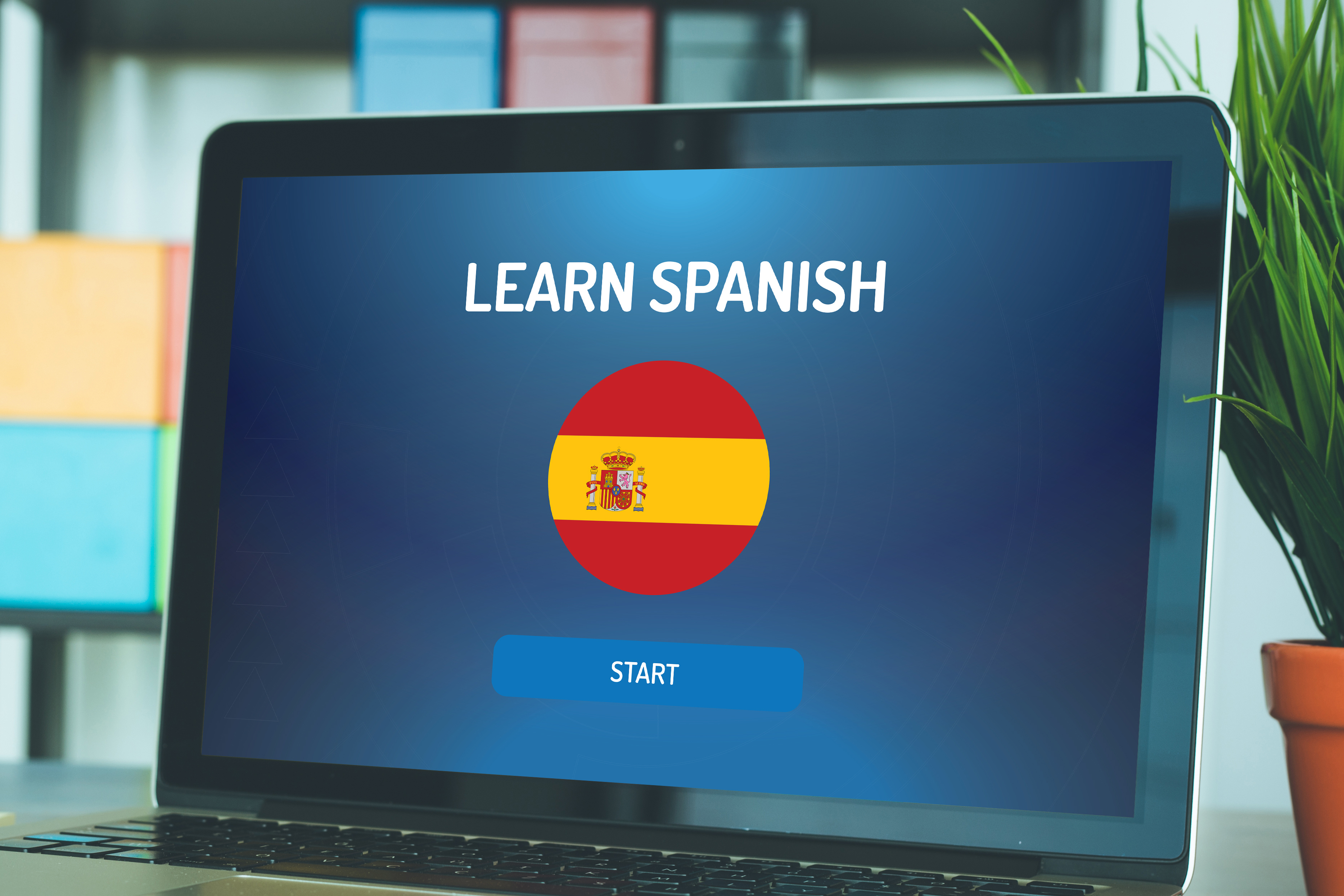
This type of student residence permit can be obtained by studying Spanish or one of the country’s official languages: Basque, Catalan, Galician, or Valencian. Participating in the program provides an opportunity to learn the language and practice speaking with native speakers simultaneously.
To apply for a residence permit, you must enroll in a full-time course at a school or center accredited by the Cervantes Institute. Residence permits are not issued for studying the native or official language of the applicant’s country; the program is designed specifically for foreign language instruction. Only adults can apply, as language courses are not intended for schoolchildren.
You must also confirm that you have at least EUR 600 per month for the entire period of your stay, plus funds to cover the tuition.
Required documents:
- Bank statements or proof of income.
- Proof of enrollment in the course.
- Receipt of payment for the registration fee.
A decision will be made within 1 month.
The validity period is for the duration of the course, not exceeding 1 year. It can only be extended once for an additional year.
Residence permit through marriage
Spouses and registered partners of foreign residents can move to Spain. If the partnership is not legally recognized, proof of cohabitation for at least 1 year or shared children must be provided, such as a rental agreement, joint bank accounts, and other relevant documents. A residence permit through marriage allows you to live and work in Spain without additional permits.
To qualify, your spouse must have lived in Spain for at least 1 year. At the time of application, they must have had a valid residence permit for at least 12 months.
The minimum family income threshold is EURF 900 per month.
Required documents:
- a certificate of divorce from your previous spouse, if this is not your first marriage;
- information about the sponsor’s source of income (work or entrepreneurship);
- a statement from the sponsor confirming that no other spouse or partner is currently living with him;
- a marriage certificate or proof of partnership.
The application processing time is two months.
The validity period of the residence permit will be the same as that of the spouse but no less than 1 year.
After 1 year, the residence permit can be modified, and an independent residence permit can be obtained for 4 years. To do so, you must confirm that you are employed and provide proof of your own accommodations in Spain.
In Spain, there is also a special residence permit for spouses of EU citizens. Your spouse must be employed, self-employed, a student, or financially independent. Income is assessed individually, and it must cover the family’s expenses without applying for social assistance. You must request a residence permit within 3 months of entering the country. The application is reviewed within 90 days. A residence card for family members of EU citizens is issued for up to 5 years.
Residence permit through family reunification
Residents of Spain, including Spaniards and citizens of other EU states, can invite their relatives to Spain for reunification. You may reunite with minor children, adult dependent children, a spouse or partner, and parents over 65 years of age who are financially dependent on you.
To begin the process of inviting relatives, a foreigner must have lived in Spain for at least 1 year and request a residence card for at least another 12 months. An exception is if a person has a permanent residence permit. Also, the foreigner must have a stable income of at least EUR 900 per month for the sponsor and one relative, plus an additional EUR 300 for each additional family member.
Required documents include a child’s birth certificate or a marriage certificate to confirm family ties. You will also need a certificate of employment or company registration to prove the sponsor’s stable income.
The application is processed by the migration service in 2–3 months.
The validity period depends on the sponsor’s status. If the sponsor is a Spanish resident, the relative is issued a residence permit valid for the same period as the sponsor’s card. If the sponsor is an EU citizen, a family member card is issued to the relative for up to 5 years.
Apply for a Spanish residence permit and open up new opportunities
- Life in a developed country
- Residence permits for all family members
- Prospects for permanent residence and citizenship
- Traveling in Europe without visas

Leave an application and get a consultation specialist
Residence permit for retirees
There is no separate residence permit for retirees in Spain; they issue the same residence permit for financially independent individuals. To confirm income, statements of regular pension payments or an official certificate from the pension fund are suitable. The minimum income is calculated based on 400% of the IPREM, which is approximately EUR 2,400 per month. If your pension is below this amount, you can make up the difference with savings or passive income, such as rent or dividends.
Registration, terms, and extension of a Spanish residence permit for retirees follow the same procedures as for other financially independent applicants.
Residence permit based on settlement
This residence permit is issued under exceptional circumstances after 2-3 years of residence in the country. It can be requested by someone who:
- Has relatives who are Spanish residents.
- Is sufficiently integrated into society.
- Was refused a residence permit renewal, but not due to criminal charges or illness.
- Has had one or more labor contracts in the country.
- Is studying or needs to undergo a training course to improve their qualifications.
This type of residence permit is intended for individuals living in Spain without legal status who can prove a stable connection to the country.
To obtain a residence permit under arraigo social, you must have lived in Spain continuously for at least 3 years and have one of the above reasons to stay. You must also have an employment contract of at least 1 year or a self-employment plan with proven income.
Required documents:
- Proof of residence in Spain for a period of three years, such as a municipal registration certificate.
- Bank statements or payslips to demonstrate proof of income.
- Documentation confirming eligibility for this type of residence permit, such as an employment contract or proof of family ties.
The application process takes 3 months.
The validity period is 1 year. At the end of the period, it is typically replaced with a standard residence permit for work or self-employment.

Residence permit for refugees
Upon receiving refugee status or subsidiary protection, a residence card is issued for 5 years. In Spain, there is a distinction between international protection and humanitarian residences; these are different programs with different requirements.
A humanitarian residence permit may be issued to victims of serious crimes, domestic violence, or labor exploitation; people with serious illnesses who cannot receive treatment in their home country; and others in need of humanitarian protection. If an applicant cannot safely return to their home country to submit documents, their case may be considered for humanitarian reasons if there is supporting evidence.
A humanitarian residence permit allows for unlimited employment and self-employment.
Required documents include proof of your situation, such as court orders, medical reports, police reports, or evidence of persecution.
After submitting an asylum application, the applicant receives a temporary residence permit (tarjeta roja), which may lead to international protection or a humanitarian residence permit. Processing an application takes at least 3 months.
The validity period is 1 year, with the right to extend for the same period.
Spanish permanent residence permit
A permanent residence permit in Spain is a residence permit issued for an unlimited period. This means that, once you receive permanent residency, you no longer need to renew your residence permit. However, you must renew your permanent residence card, which is initially issued for 5 years. After the second renewal, it is issued for 10 years if the immigrant is over 30.
Another difference between permanent and temporary residency is that with permanent residency, you can work as an employee or self-employed individual without restrictions, just like Spanish citizens.
Permanent residency is usually granted only with a Spanish residence permit.
You can obtain permanent residency after 5 years of legal residence in Spain. Early access to permanent residency is possible for individuals of Spanish descent who have lost their citizenship and for those who have made exceptional contributions to the country. If you were born in Spain and have reached the age of majority, you can apply for permanent residency if you have lived in Spain for 3 years prior to applying.
It’s important to meet the continuous residence requirement: over a 5-year period, your trips abroad cannot exceed 10 months in total and no more than six months consecutively. For business trips, up to 12 consecutive months are permitted.
Regardless of the type of residence permit you held in Spain; you can apply for permanent residence. Periods of residence in other EU countries even count if you have a Blue Card. However, keep in mind that not all residence permits allow you to reside in Spain for 5 years straight. For instance, if you came to Spain to study the local languages, after 2 years, you will need to apply for a permit for another purpose, such as studying at a university or working.
Which type of residence permit should you choose?
Your choice should be based on your capabilities, your ultimate goals, and the specifics of each permit. After all, the obvious solution isn’t always the best one. For instance, if you want to move your business to Spain, immigrating for business reasons makes perfect sense. However, in this situation, experienced immigration lawyers will recommend a startup visa because it’s processed 3 times faster and issued for 3 years instead of 1. Therefore, many future immigrants consult international law specialists, which helps them save money and time while securing the best possible outcome.
General advice on choosing the right type of Spanish residence permit based on your circumstances:
- If you have relatives in Spain, residency through family reunification is the easiest to obtain, especially since it can be modified later.
- For remote workers, the Digital Nomad Visa is ideal because it allows you to apply for a 3-year residence permit.
- If you have a passive income of at least EUR 2,400 per month, it’s worth applying for a residency permit for financially independent individuals.
- Entrepreneurs are better off applying for a startup visa because it’s easier to obtain, and they’ll receive tax benefits.
- If you’re traveling to Spain solely for work, apply for a work residence permit.

The procedure for obtaining a residence permit in Spain
The procedure for obtaining a residence permit in Spain varies depending on the type of permit. There are different lists of required documents, and applications can be submitted either abroad or within the country. However, the general process of immigrating to Spain includes the following steps:
- Select the appropriate basis and prepare the necessary documents
It’s important to choose the basis carefully, so it’s advisable to consult immigration specialists. They can also help you prepare your application. The general list of required documents includes a passport, photo, certificate of no criminal record, health insurance, and completed application form. Income statements are often required. Documents issued in a foreign language must be translated into Spanish by a sworn translator. Some documents require an apostille or certification.
- Obtain a long-term visa
Often, a visa is processed through the consulate first. First, you need to schedule an appointment online. Then, on the appointed date, you must arrive with a complete set of documents and submit them for preliminary approval. At this stage, the residence permit fee is paid. The fee varies depending on the reason for the visa, but it is usually around EUR 11. To obtain a startup visa, you must first receive ENISA and UGE-CE approval, a process that is completed online.
Once your application is approved, you will receive a notification and can apply for a visa. There is a time limit for this application, for example, self-employed individuals are given 1 month. After another month, you can pick up your passport. The visa costs approximately EUR 89.
- Relocate to Spain
A visa is typically valid for 3 months and allows entry into the country and issuance of a residence permit. However, digital nomads do not require a residence permit and can live on a visa alone for the entire year. If you are an employee or entrepreneur, you must register with the social security system within the first 90 days of arrival. Without doing so, you will not be able to apply for a residence permit.
- Obtain a residence permit
A residence card is issued within the first month of moving to Spain at the local police station. The validity period depends on the basis on which it was issued. The cost of a residence card is approximately EUR 16.
Why a Spanish residence permit might be denied or revoked
A Spanish residence permit may be denied, particularly if the applicant lacks experience obtaining such documents. The most common reasons for refusal or revocation of a Spanish residence permit are:
- The person does not meet the requirements of the residence permit they are applying for. This usually occurs when the applicant does not provide all the necessary documents. For example, when applying for a Digital Nomad Visa, the applicant does not provide a certificate from their employer confirming that they can work remotely.
- The applicant’s file contains forged documents. This suspicion may arise if the applicant incorrectly enters their first or last name or the dates on their visa application form. Therefore, it is best to consult a lawyer when completing your application.
- The person poses a threat to society. Refusal or revocation on this basis is possible if legal proceedings are pending against the foreigner. To restore your residence permit, you must provide documents confirming acquittal or an overturned conviction.
- The type of activity does not correspond to the declared one. For example, financially independent individuals are not allowed to work in Spain. If you wish to find employment, you must apply for a work-related residence permit.
When applying for a work-related residence permit, an employer may be denied if they do not meet the necessary requirements. For instance, they cannot hire foreigners if they have unfairly dismissed employees within the last year.
7 benefits of obtaining a Spanish residence permit
Spain is one of the most popular countries among expats, with an estimated 9 million living there. This is largely due to its warm climate, access to the Mediterranean and Atlantic Oceans, vibrant cities, and cuisine. However, local residency status offers many advantages. A Spanish residence permit grants the right to:
- Permanent residence in the country, often with the right to work or conduct business.
- Travel: You can spend up to 90 days out of every 180 days in other Schengen countries.
- The freedom to leave the country and return to Spain an unlimited number of times.
- Education for children: You can enroll your child in a free public school.
- Tax incentives: For example, startup founders pay 15% corporate tax instead of 25% for the first 4 years.
- Access to a wider range of banking services than non-residents have, such as favorable loans.
- The opportunity to obtain permanent residency after 5 years and EU citizenship after an additional 5 years.
Spain offers a wide variety of residence permits, so you can find the perfect one for you. If you’re unsure about how to obtain a Spanish residence permit, consult immigration specialists. They can help you determine the best basis for your move and handle all the necessary paperwork, including preparing your application, translating your documents, and notarizing them. Having experienced lawyers involved significantly reduces the risk of rejection and speeds up the immigration process. Leave a request for a free consultation on immigrating to Spain.
Get a consultation