
Swiss banks remain the gold standard for reliability and service quality. For Swiss residents, an account is essential for receiving a salary, paying taxes, and managing everyday financial matters. Non-residents open Swiss bank accounts primarily for asset protection and capital preservation in the world’s most stable currency, as well as for access to global markets via Swiss brokers.
Although opening a Swiss bank account is still surrounded by myths, there are far fewer “impossible missions” involved than might be thought. In this article, we will explore the following questions: is it possible to become a bank client without a residence permit? Are accounts anonymous? Can accounts be opened with a zero balance? To give you a quick preview, a Swiss bank account can be opened by a non-resident, although the vetting process will be stricter. And yes — you can become a client of a Swiss financial institution without being a millionaire.
How does the Swiss banking system work?
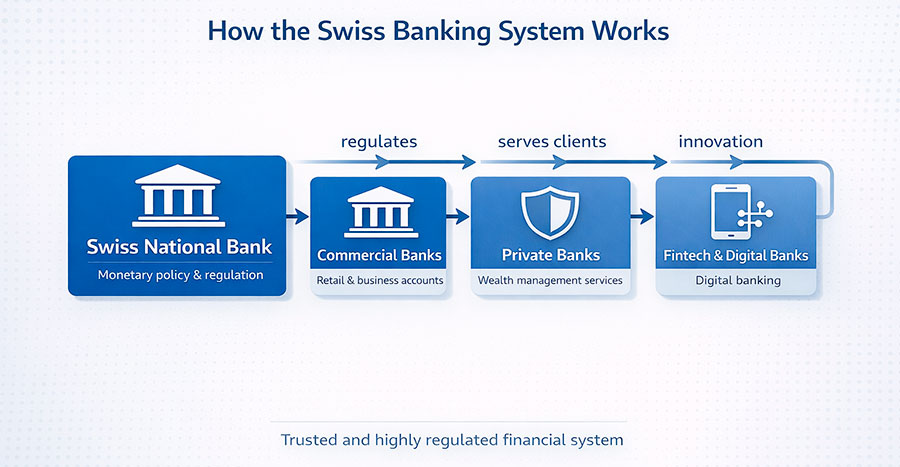
The Swiss banking system is considered one of the most stable in the world. Its evolution has resulted in a sophisticated financial infrastructure and a high level of capital protection, alongside strict regulatory requirements.
The Swiss banking sector is divided into 3 tiers, each with its own specific role:
- Big Banks (large and systemically important), such as UBS and Credit Suisse. They operate globally and offer a full range of services.
- Cantonal banks are owned by the cantons (regions). Examples include ZKB (Zurich) and BCV (Vaud). Many such institutions benefit from a state guarantee, meaning that if the bank fails, the cantonal government will reimburse your funds.
- Private Banks specialize in wealth management. They cater to clients who value personalized approaches and sophisticated investment strategies. Such banks actively serve international clients, including non-residents.
The National Bank serves as the primary market regulator.
Swiss banking secrecy has weakened in recent years. Although data protection laws have existed for over 90 years, the system has evolved, and since 2017 the country has participated in the AEOI (an international system for exchanging financial information). Furthermore, if you are a tax resident of a country that participates in the Common Reporting Standard (CRS) for the automatic exchange of financial data, a Swiss bank will transmit information about your account balances to the relevant tax authority. Consequently, those seeking maximum anonymity often opt for jurisdictions that are less active in sharing personal data, such as the UAE or Vanuatu.
Swiss banks continue to robustly protect client data from commercial entities, hackers, and unjustified inquiries. Disclosing banking information in Switzerland without a court order is a criminal offense.
Switzerland is a global leader in the fight against money laundering. The ‘Know Your Customer’ (KYC) procedure is rigorous here, often resembling an interrogation. To open a bank account, you must prove the source of every single franc. If you claim to have sold an apartment or received dividends, for example, you must be prepared to provide documentary evidence. New beneficial ownership transparency rules, introduced in 2026, will make it impossible to hide the true owner of an account behind a chain of offshore entities.
The Swiss franc (CHF) remains stable, even amid volatility in the US dollar and the euro. The country operated with negative deposit rates for a long time, but rates are now positive. However, do not expect high interest yields; in this case, you pay for security rather than returns. In the event of a bank failure, statutory protections come into effect in Switzerland:
- Privileged payments: Up to CHF 100,000 is paid out immediately from the bank’s liquid assets.
- Esisuisse (deposit insurance system): If a bank’s liquidity is insufficient, a solidarity fund backed by all Swiss banks will step in. You can verify whether your bank is part of this system on the Esisuisse website.
- Third-tier claims: Any remaining amount falls into the third tier of creditor claims and is paid out following the liquidation of the bank’s assets.
Account types and their features
The types of accounts offered by Swiss banks vary in terms of service conditions, requirements, and purpose. Some are only available to high-net-worth individuals.
Current Accounts are suitable for everyday needs, such as receiving a salary, paying rent, linking a debit card, and making payments via TWINT, a Swiss mobile payment system. A notable feature of current accounts is the low interest rate on the account balance, which is often zero. Such accounts can be opened in Swiss francs or other currencies, such as euros or US dollars. A standard maintenance fee is usually charged to all clients.
A Savings Account is designed to hold a financial ‘safety net’. It allows funds to accumulate at a slightly higher interest rate. In 2026, interest rates for these accounts will range from approximately 0.5% to 1.2% per annum. A key feature of these accounts is the limit on cash withdrawals. For example, you can withdraw up to CHF 20,000 (EUR 22,050) per month, but larger amounts usually require three months’ notice. Debit cards are not issued for these accounts.
The Swiss banking system allows savings accounts to be opened in US dollars, euros, or Swiss francs. Such an account is usually only opened in conjunction with a current account or if the client is a Swiss resident.
An Investment Account (also known as a Custody Account) is designed for purchasing stocks, bonds, exchange-traded funds (ETFs) and Swiss Real Estate Funds. A notable characteristic of this type of account is the substantial custody fee, which typically ranges from 0.5% to 0.95% of the invested assets. Availability is restricted for non-residents.
Some banks, particularly cantonal banks, do not open investment accounts for citizens of certain countries. For example, this applies to clients in the USA under the Foreign Account Tax Compliance Act (FATCA), which aims to prevent American taxpayers from hiding money abroad. Under this law, financial institutions worldwide (including banks, investment funds and insurance companies) must identify ‘U.S. persons’ among their clients and report their accounts to the U.S. Internal Revenue Service (IRS).
A Pillar 3a Account is a specialized Swiss banking product for retirement savings. It is a form of voluntary pension provision offering a tax benefit: the contribution amount is deducted from your taxable income, resulting in annual tax savings of up to a few thousand francs. Funds in the account are ‘locked’ until retirement. Early withdrawal is only permitted in three specific cases: purchasing a home, starting a business, or permanently leaving Switzerland. This account is only available to residents who earn income subject to Swiss taxation.
A Numbered Account is a type of account often seen in movies. It is characterized by heightened internal confidentiality. Instead of your name, an alphanumeric code is used, and only a select group of senior executives know your personal details. However, it is not truly anonymous; the bank holds your full information and discloses it to tax authorities upon request or through information-sharing agreements. It simply provides an extra layer of protection against ordinary bank staff. Maintenance costs for such an account can reach CHF 2,000 per year. A Numbered Account can be a current or investment account.
These accounts minimize the risk of information about the account balance leaking to malicious actors or blackmailers.
Private banking is a specialized service designed exclusively for high-net-worth clients. In addition to standard services, some banks, such as Kaleido and UBS, offer concierge services, expanded access to investment platforms, and asset management systems.
Can foreigners open accounts in Switzerland?
You will need a Swiss account if you plan to work or conduct business in the country, purchase real estate (you will need to pay taxes, transaction costs, and future utility bills), or manage assets and make investments. You will also need an account when arranging long-term health insurance. If you plan to obtain a Swiss residence permit, you may need an account to demonstrate financial solvency.
However, you can do without a Swiss bank account if your goal is simply to handle transactions within Europe. For example, if you have a French bank account, you don’t need a Swiss one for international payments; the French account will suffice. Moreover, it is much easier to open an account in France, especially if you already have a residence permit, which is relatively easy to obtain.
A traditional bank account is not necessary for investing through brokers. Access to global markets can be obtained via a brokerage platform. Alternatively, you can use a neobank (such as Revolut or Wise) instead of a traditional bank account, as they offer multi-currency account details.
The requirements for opening a bank account are generally consistent, though they may vary depending on the type of institution and your “risk profile.” Non-residents must verify their address and country of tax residence and provide information about their employment, income, and the source of their funds. Banks may request additional information at their discretion, particularly if a large sum is to be transferred to the new account.
In most cases, Swiss banks require non-residents to make a minimum deposit. The amount depends on the type of financial institution and the level of service:
- Digital Neobanks: from CHF 0 to CHF 1,000 (though they do not open accounts for non-residents from every country);
- Traditional banks usually require a minimum deposit of between CHF 50,000 and CHF 100,000;
- Private banking: from CHF 250,000 to CHF 500,000;
- Private banks that specialize in wealth management require a minimum deposit of CHF 1 million.
Some financial institutions charge an additional fee for maintaining accounts for clients residing outside of Switzerland. For example, PostFinance charges a fee of CHF 25 per transaction. This amount is charged in addition to the cost of the chosen service package, such as the “Smart” package for CHF 5. Consequently, the total monthly account maintenance cost is at least CHF 30. Some banks waive this fee for new clients and for those living in neighboring countries: France, Austria, Germany, Italy, and Liechtenstein.
Swiss banks reserve the right to refuse to open an account without providing a reason. This most often occurs due to several factors:
- The source of funds is not transparent, for example: if a foreign national cannot prove how every franc was earned (e.g., missing documentation regarding a business sale from a decade ago or an unclear history involving crypto-assets);
- Links to sanctions lists: even if you are not personally on a list, a connection via your company or business partners will result in an immediate refusal;
- PEP (Politically Exposed Person) status: banks are extremely reluctant to open accounts for politicians and their relatives, doing so only after exhaustive due diligence;
- Residence in a “gray zone” country: if you are a resident of a country included on FATF lists indicating a high risk of money laundering;
- Tax opacity: if the bank doubts that you will declare the account in your home country;
- Low volume of funds: some banks do not handle small non-resident deposits because servicing them is often not economically viable.
- Find a program that fits your budget
- Compare requirements and benefits across countries
- Choose the right route to a residence permit
How to open a bank account in Switzerland
The method for opening an account depends on two main factors: the client’s status (Swiss resident or non-resident) and the type of bank selected.
Generally, you can apply to open an account at a branch or online. Some banks allow you to complete the entire process remotely using a video verification system. First, you download an app or fill out an application on the website. Then, you upload the necessary documents. A representative will then contact you to conduct a video identity check. The bank then performs the required checks and decides whether to open the account. With online banks, this process typically takes just 1–3 days.
However, this option is not available at all banks for non-residents. For example, UBS accepts applications from Swiss residents only via its app. Regarding online banks, Neon, known for its customer-friendly terms and ease of use, only accepts applications from individuals living in Switzerland who are tax residents and hold citizenship in specific countries, such as the UAE, Chile, and France.
Another online bank is Yuh, a joint venture between PostFinance and Swissquote. Yuh allows users to invest in stocks and cryptocurrency directly through the app and facilitates easy transfers to other banks, including international ones. However, accounts can only be opened by individuals residing in Switzerland, Austria, Liechtenstein, Germany, France, or Italy. If you have a French residence permit (e.g., obtained via a startup visa or proof of financial independence), you can apply without issue. Swissquote is another online bank and broker that is a good choice for non-residents who want to invest. Dukascopy Bank readily opens multi-currency accounts for everyone except residents of certain countries.
It is much easier for a non-resident to open an account at a bank branch. The standard opening procedure involves:
- Scheduling an appointment. While you can walk into a branch, it is better to contact a manager beforehand to inquire about the terms and available account types.
- An interview with the manager, who will ask about the purpose of opening the account (e.g., salary, savings, or investments) and the expected transaction volume.
- Documentary compliance. You will submit original documents, undergo identity verification, and sign an application.
- Source of Funds Verification. For large amounts, you will be asked to provide tax returns or contracts.
- Wait for a decision. At traditional banks, the verification process takes anywhere from 3 days to 2 weeks.
Foreigners can open an account at UBS, the country’s largest bank, which has a dedicated department for foreign clients. Cantonal banks, such as ZKB or BCV, are suitable options if you live in a specific region. Although their operations are generally limited to the canton, these institutions serve non-residents and offer deposit, current, and corporate accounts.
Required documents
To open an account at a Swiss bank, you will need the following documents:
- Certified copy of a passport. If opening a Swiss account remotely, the copy must be notarized. Some digital banks allow video identification instead.
- Proof of current income. This could include bank statements, certificates of work completion, or contracts.
- Proof of address. You can use an original utility bill (gas, electricity, or internet) or a bank statement showing your home address. The document must be no older than 3 months.
- Information on the source of funds. The bank may request salary statements from the last 6–12 months, asset sale agreements (business or real estate), or tax returns from previous years.
Each situation is unique, and the bank reserves the right to request additional documents, such as a CV, details regarding your country of tax residence, statements and references from other banks, or information on current income (salary or business profits).
We collect and prepare the complete set of documents in accordance with Swiss authorities’ requirements.
Where to open an account in Switzerland?
Swiss banks fall into several categories:
- Global systemically important banks (Big Banks)
Universal giants. Following the merger of UBS and Credit Suisse, UBS is the dominant player here. They typically offer a full range of services for private and corporate clients, from private banking to investment accounts, and maintain extensive branch networks. - Cantonal banks
Cantonal banks are owned by the regions (cantons). Their services are usually focused on a specific territory. They are reliable and often backed by a state guarantee. Examples: ZKB (Zurich) and BCV (Vaud). - Fintech and neobanks
Fully digital with no physical branches. They are the most affordable and fastest options. They typically specialize in online trading, cryptocurrency, and investments. Examples: Neon and Yuh. - Private Banks
Private banks primarily serve high-net-worth clients, offering personalized wealth management, investment strategies, and tax planning. Examples: Lombard Odier, Pictet, and Julius Baer.
To help you understand the differences, we have selected one bank from each category and compared their service terms in the table below:
| Comparison criteria | Neon (Fintech) | UBS (Global) | ZKB (Cantonal) | Julius Baer (Private) |
|---|---|---|---|---|
| Best suited for | Swiss residents | All client categories | Cantonal residents | High-net-worth investors |
| Account opening time | 10 минут (online) | 1–2 weeks (in person) | 3–7 days (in person) | 2–4 weeks (in person) |
| Monthly fee, CHF | Free plan | 0–22 | 0–32 | Individually determined |
| Convenience | Simple, user-friendly mobile app | Extensive branch network | Large branch network, 24/7 communication | Dedicated relationship manager, 24/7 support |
| Services for non-residents | No | Yes | Yes | Yes |
The best bank for you depends on your specific situation. If you have moved to Switzerland and need a card for your salary and daily transactions, online banks like Neon or Yuh are good options. However, if you require physical branches, you might consider a cantonal bank. Those planning to invest may want to use online banks and brokers like Swissquote. Private banks are ideal for holding substantial capital. However, if you plan to start a business and engage in frequent international transactions, it is better to bank with a large institution such as UBS, which has extensive infrastructure.
Digital banks like Yuh and Swissquote offer the easiest route for non-residents from neighboring countries. Private banking services (Lombard Odier, Pictet, and Julius Baer) are suited to serious investors.
Bank cards in Switzerland
Bank cards in Switzerland are highly secure tools that require their holders to be knowledgeable about their use. If your behavior triggers the bank’s security algorithms to flag it as suspicious, the card can be blocked in a matter of seconds.
Switzerland is gradually phasing out older standards (Maestro/V-Pay) in favor of more modern solutions:
- Debit Mastercard/Visa Debit, the most popular type. Funds are deducted immediately. Suitable for online payments and linking to Apple Pay or Google Pay;
- Credit cards (Classic, Gold, and Platinum) allow for a negative balance thanks to a credit limit. They often include travel and car rental insurance;
- Prepaid Cards are ideal for budget control. Load the card with funds via an app, and then spend them. It’s a safe option for online shopping.
- Travel Cards are specialized cards (e.g., from Swiss Bankers) denominated in CHF, EUR, or USD. They are designed to minimize currency conversion costs while traveling.
Each card has limits that can often be adjusted via the mobile app. The standard daily limit for cash withdrawals and in-store purchases is usually between CHF 1,000 and CHF 5,000. There may also be limits on contactless payments. Transactions up to CHF 80 can be made without a PIN, but a PIN is required for higher amounts.
Swiss banks are extremely vigilant. A card will be blocked if there are signs of “geo-fraud,” such as a client suddenly using the card in the Maldives after buying coffee in Switzerland the day before without notifying the bank of the trip. A series of small purchases on unfamiliar foreign websites or spending that exceeds your normal patterns will also raise red flags. For example, if you usually spend CHF 2,000 a month, but suddenly attempt a high-value purchase of CHF 50,000, the bank may block the transaction pending telephone confirmation. A common reason for a card to be blocked is entering the wrong PIN 3 times in a row. Unblocking the card often requires calling the bank or visiting a branch.
Tips for using your card abroad:
- Activate Geoblocking. You will need to manually unlock the regions you are visiting (e.g., Asia or the USA) in the banking app. By default, only Europe is often enabled;
- Choose the payment currency. If a terminal abroad offers a choice of currencies, always select the local currency (e.g., CHF). If you choose CHF, the bank will apply a dynamic currency conversion (DCC) rate;
- Consider fees. Remember that Swiss banks charge a fee for cash withdrawals abroad (usually 4% of the amount, with a minimum of CHF 10 per transaction). Using a card is more cost-effective than withdrawing cash;
Swiss bank accounts and taxes
Opening a bank account in Switzerland does not automatically make a foreigner a tax resident of the country. Tax residency is established by permanently residing in the country for more than 183 days a year, relocating one’s center of vital interests, assets, and business to Switzerland, or purchasing a permanent home there.
If you are a Swiss tax resident, you are liable for taxes in Switzerland on your worldwide income and assets, including accounts held abroad. Switzerland also levies a wealth tax—a small percentage (ranging from 0.1% to 1.1%, depending on the canton) of your total assets, including bank account balances.
Switzerland actively participates in the system for the automatic exchange of information. This means you cannot “hide” money there. Banks transmit details such as your name, address, date of birth, tax identification number, year-end account balance, and investment income (interest and dividends). This data is sent to the Swiss Federal Tax Administration (ESTV) and subsequently forwarded to the tax authorities of your home country.
The CRS 2.0 standards took effect in 2026. Information exchange has become more detailed, and oversight of “forgotten” accounts and complex structures, such as trusts and foundations, has tightened. Crypto assets held in custodial wallets are also under scrutiny.
Switzerland imposes one of the world’s highest withholding taxes on investment income: 35%. In practice, if a bank credits you with 100 CHF in interest, it automatically withholds 35 CHF and remits it to the Swiss treasury. You receive only 65 CHF. This is a deterrent tax designed to encourage the declaration of income. However, you can reclaim the withheld 35% after filing a tax return.
Special rules apply to individuals with a U.S. passport or U.S. tax residency. Under U.S. FATCA law, Swiss banks must transmit data directly to the IRS. Many banks still refuse to open accounts for “U.S. persons” to avoid the burden of complex reporting requirements.
Risks and limitations
Despite its neutrality, Switzerland has aligned its sanctions lists with those of the EU and the US to nearly 100% in recent years. Access to the account will be blocked immediately if the name of a foreign national, their company, or a business partner appears on a sanctions list (SECO, OFAC, or EU).
Strict limits apply to citizens of sanctioned countries. For example, there is a ban on accepting deposits exceeding CHF 100,000. An account may be frozen not only for political reasons but also for technical triggers. For example, a large transfer (over CHF 1,000) to a Swiss account made without prior notification to the account manager may result in the account being frozen.
If the bank requests an update to tax residency details or an explanation of the source of funds and you fail to respond within 2 to 4 weeks, be prepared for the account to be blocked. Access will also be cut off if your international passport or residence permit expires and you do not provide updated details.
Citizens of countries on FATF lists (jurisdictions with a high risk of money laundering) are subject to enhanced due diligence (EDD) procedures. The bank will require more than proof of income; it will require a full history of your capital. The account opening process can take several months.
The bank reserves the right to close an account unilaterally without providing a reason, usually with 30–60 days’ notice. This often happens with “unprofitable” clients, such as non-residents who maintain low account balances yet require significant attention from the compliance department.

If you need to open an account in a jurisdiction with less stringent rules, book a consultation with the . Our specialists will analyze your situation and identify the optimal solution.